What Is The Dark Web?
Not a digital sewer. Not a myth. Just a small, locked room at the back of the internet you already use every day.
The dark web is a small collection of websites that only run on special software like Tor, which encrypts and bounces your connection through several relays so that neither you nor the site you're visiting can easily be traced.
Somewhere between 0.01% and 0.02% of all internet traffic happens on the dark web, which means for every ten thousand people scrolling online right now, roughly one or two of them are somewhere you can't casually stumble into.
So what, exactly, is behind that door?
TL;DR
Quick answer
The dark web is a small collection of websites that only run on special software like Tor, which encrypts and bounces your connection through several relays so that neither you nor the site you're visiting can easily be traced.
Getting Oriented
The Internet Has Three Layers, Not One
Picture the internet as a house. The surface web is the living room, Google, Wikipedia, the news site you read at breakfast, open to anyone who walks in. The deep web is everything behind a closed door but still inside the house: your email inbox, your bank statement, a company's internal wiki. Nothing sinister, just private, and it makes up the vast majority of everything online.
The dark web is different. It's not a room in the house at all, it's a separate structure built with its own foundations, reachable only through a specific, encrypted tunnel. You need particular software, most commonly the Tor Browser, to get in, and once inside, addresses look nothing like the ones you're used to: strings of random characters ending in .onion instead of .com.
The technology itself was never designed for wrongdoing. Tor, short for The Onion Router, was developed in the mid-1990s by U.S. Naval Research Laboratory researchers who wanted a way for intelligence communications to travel online without being traced back to their source. The layers of encryption are, quite literally, why it's named after an onion.
What people do inside that tunnel is a separate question from what the tunnel is. A journalist in a country with a censored press, a whistleblower, a police department running a sting, and yes, a criminal marketplace, all of them can use the same technology, in the same way that a telephone line can carry a birthday call or a bomb threat.
The Three Layers At A Glance
- Surface web: indexed, public, roughly 4-5% of total content
- Deep web: unindexed but ordinary, logins, private databases, paywalled content
- Dark web: intentionally hidden, requires special software, a small slice of the deep web
The Layers Of The Internet
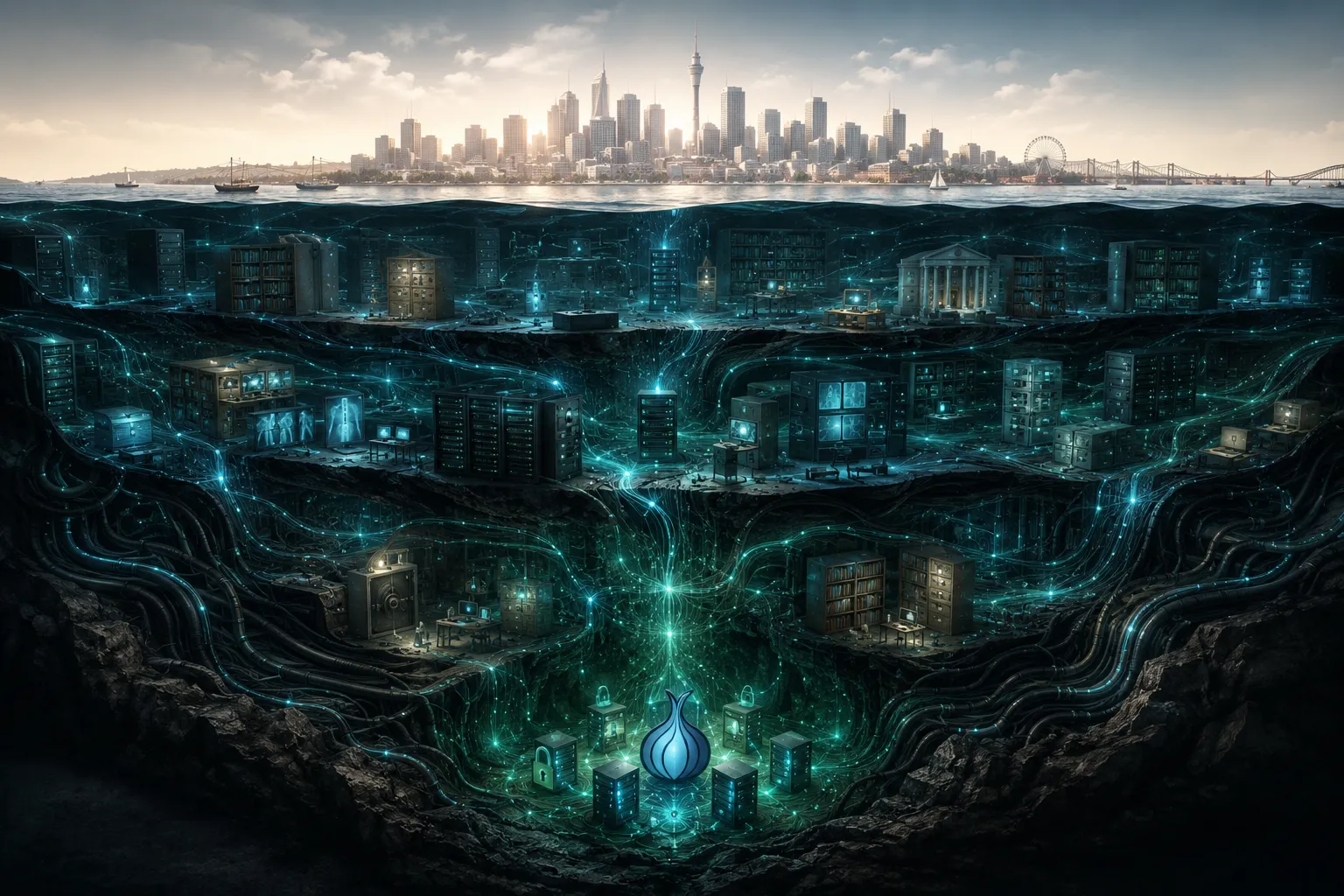
A visual breakdown of surface web, deep web, and dark web, and how much of the internet each one represents.
Surface Web
Indexed by search engines, the internet most people know
Deep Web
Unindexed but ordinary: email, banking, private databases
Dark Web
Requires special software; a small, encrypted subset of the deep web
The Strangest Thing: It Was Built By The U.S. Navy
The tool most associated with digital anarchy, Tor, was originally funded by the U.S. government to protect its own communications. The layers-of-encryption design earned it the onion nickname, and ironically, the more ordinary people who use it today for entirely mundane reasons, the better it hides the government and military traffic still running through it alongside everyone else's.
If The Internet Were A City
If the entire internet were the size of a city, how big would the dark web be?About the size of a single street corner. Estimates put dark web traffic at roughly 0.01–0.02% of all internet activity, a rounding error next to the surface and deep web combined, even though it gets an outsized share of headlines.
The Addresses Are Randomly Generated, Not Chosen
A .onion address like a string of 56 random-looking characters isn't picked by the site owner, it's mathematically derived from the site's cryptographic key. There's no domain registrar, no 'buying' a catchy name; the address is, in effect, the site's fingerprint.
This is exactly what makes it hard to impersonate a .onion site convincingly, you'd need to forge the underlying cryptographic key, not just register a similar-looking name.
Misconception
The dark web is a vast, secret internet, 90% of everything online, hidden beneath the surface.
Reality
That '90% hidden' figure describes the deep web (your email, private databases), not the dark web specifically. The dark web itself is a tiny fraction of even the deep web, closer to a locked closet than a hidden continent.
How Tor Actually Hides You
The mechanism is simpler than the mystique suggests, it's really just very deliberate rerouting.
Your data gets wrapped in layers
Before your request leaves your device, Tor encrypts it multiple times, once for each relay it will pass through.
Like sealing a letter inside envelope after envelope, each one addressed to a different post office.
It bounces through at least three relays
The request hops through an entry node, a middle relay, and an exit node, each one only knows the step before and after it, never the full path.
Each post office only knows who handed them the envelope and where to send it next, not who originally wrote the letter.
The destination site only sees the exit node
By the time your request reaches the .onion site, it appears to come from the exit relay, not from you.
The final envelope arrives with a return address that isn't yours.
So, Is The Dark Web A Big Deal?
It's a real, useful, and mostly unremarkable piece of internet infrastructure, smaller and less dramatic than its reputation.
The dark web exists, works as described, and is legal to access almost everywhere. What it isn't is the sprawling criminal underworld pop culture suggests, most of it is idle, abandoned, or entirely mundane.
Why This Technology Matters Beyond The Headlines
Strip away the true-crime documentaries and the dark web is really a case study in a much bigger question: can a network be built so that privacy is the default, not a luxury? Journalists in authoritarian states, domestic abuse survivors hiding their location, and ordinary privacy-conscious users all lean on the same infrastructure that occasionally makes the news for darker reasons. The technology is neutral; the headlines rarely are.
Questions people ask
If You Found This Interesting...
What's the actual difference between the deep web and the dark web?
A closer, side-by-side look at the two terms people constantly mix up.
How do you actually get onto the dark web?
The practical, step-by-step version of what this article only sketched.
What was Silk Road?
The most infamous dark web marketplace, and why its takedown changed everything.
Is Tor really untraceable?
A myth-busting look at what Tor can and can't hide.
What's the difference between Tor and a VPN?
Two privacy tools people confuse constantly, here's how they actually differ.
You now know
- The dark web is a small, encrypted subset of the internet reachable only with special software like Tor.
- It's legal to access in most countries, legality depends on what you do there, not that you're there.
- It represents a tiny fraction of overall internet traffic, despite its outsized reputation.
Safety note
Educational, not operational
This guide is educational. It does not provide instructions for illegal activity, evading law enforcement, buying prohibited goods, or attacking systems. Laws and risks vary by country, so stay within your local rules and avoid interacting with unknown services.
Common myth
Myth vs reality
The dark web is a vast, secret internet, 90% of everything online, hidden beneath the surface.
That '90% hidden' figure describes the deep web (your email, private databases), not the dark web specifically. The dark web itself is a tiny fraction of even the deep web, closer to a locked closet than a hidden continent.
Sources
Further reading
- Tor Project official documentation
- U.S. Naval Research Laboratory historical archives
- Independent dark web traffic measurement studies
Glossary
Terms in this guide
Continue learning