Is Tor 100% Untraceable?
No. Tor is not 100% untraceable, and the Tor Project does not claim that it is. Tor is designed to make it much harder for an observer to connect who you are with where you go online, but it cannot protect against every possible way a person can be identified.
No. Tor is not 100% untraceable. The useful question is what failed: the Tor network, the browser or endpoint, the onion-service server, personal OPSEC, cryptocurrency privacy, institutional metadata or ordinary investigation outside Tor.
The important distinction is how Tor users actually get identified. When a Tor user or onion-service operator is caught, that does not necessarily mean someone "broke Tor." In documented cases, investigators have used everything from browser exploits and server leaks to reused email addresses, network logs, cryptocurrency trails and conventional police work. There are also documented cases involving attacks against Tor network layer itself.
I reviewed 17 documented cases of Tor users, onion-service operators or Tor-based services being identified to separate these mechanisms. The pattern is more complicated than either "Tor is untraceable" or "the government can crack Tor whenever it wants."

Disclosure
Method note
This article is based on a curated public-case review. It does not claim to measure how all Tor deanonymization attempts work.
Definition
What does "traceable" mean with Tor?
The word traceable compresses several different questions. Can an ISP see that someone connected to Tor? Can a destination website see the user's real IP address? Can an adversary watching enough of the network correlate traffic timing? Can malware make the user's computer report its own IP address? Can investigators identify a person through an email address, username, payment trail, campus log or seized server?
Those are not the same question. An ISP seeing a Tor connection is not the same as knowing which onion service the person used. A seized onion-service database is not the same as breaking Tor routing. A browser exploit that makes a computer call home is not the same as decrypting Tor traffic.
Anonymity can fail without Tor's encryption being broken. That distinction is the backbone of the evidence. In the public cases I reviewed, identification usually came from a layer around Tor, not from someone simply decrypting the onion-routed connection.
The distinctions that matter
- Tor usage visibility is not the same as destination visibility.
- Destination visibility is not the same as real-world identity.
- A targeted traffic-correlation attack is not a general ability to see all Tor users.
- A browser or server exploit can expose a user even if Tor routes packets as designed.
The layer that failed matters
Being identified while using Tor does not tell us which layer failed. A useful analysis separates network attacks from endpoint exploits, server leaks, OPSEC failures and external evidence.
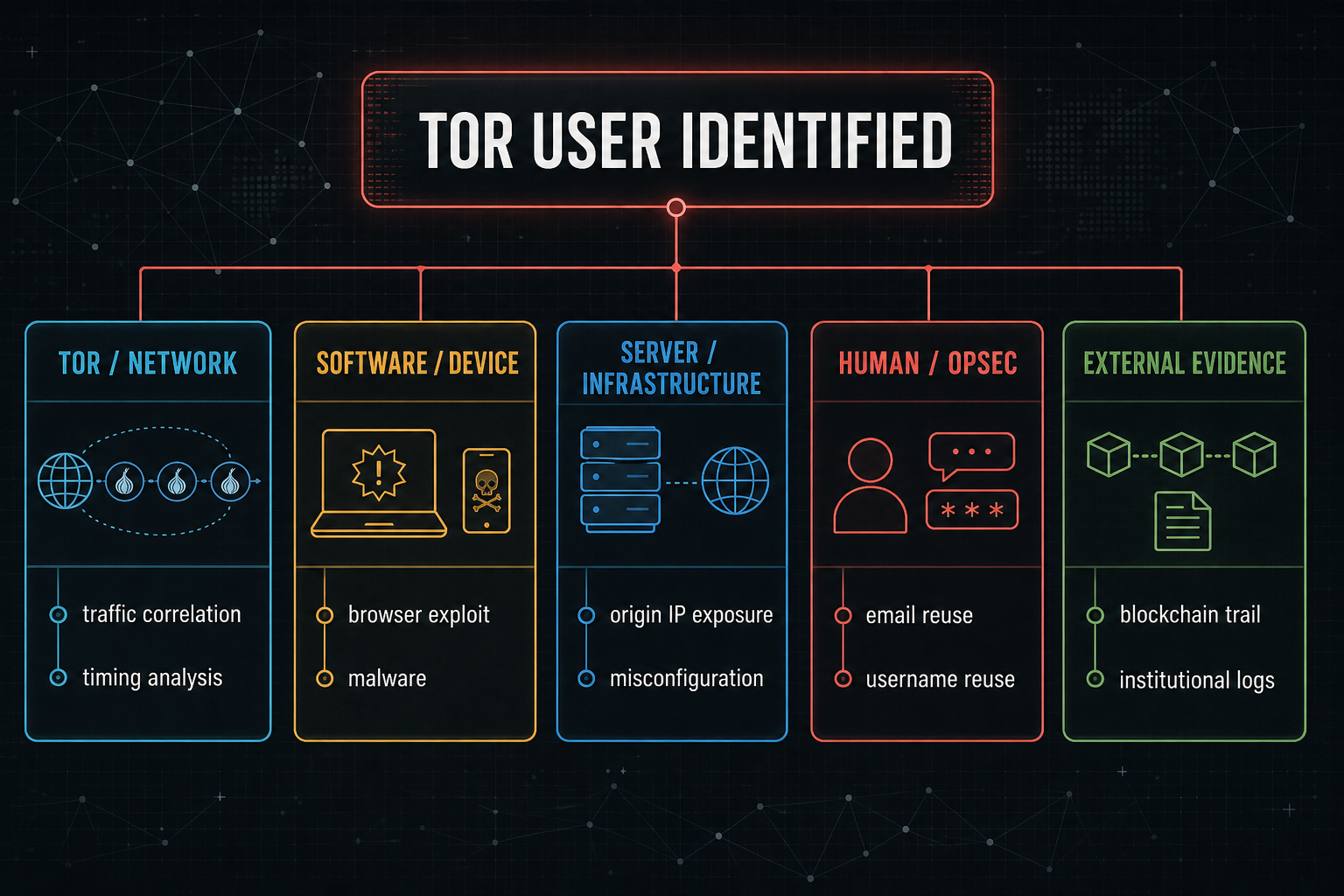
Tor or network
Traffic correlation, malicious relays, timing analysis and guard discovery.
Software or device
Browser exploits, malware and endpoint compromise outside Tor routing.
Server or infrastructure
Onion-service origin IP exposure, hosting records, logs and configuration leaks.
Human or external evidence
Email reuse, usernames, blockchain trails, institutional logs, surveillance and warrants.
How I reviewed the cases
I looked for publicly documented cases in which a Tor user, onion-service operator or Tor-based service was successfully linked to a real person or location. I prioritized court documents, government records, Tor Project material and academic research, then used reputable technical reporting to clarify disputed or incomplete accounts.
I classified each case by the main mechanism that contributed to identification: a Tor or network attack, endpoint exploit, server leak, OPSEC failure, financial trace, institutional metadata or conventional investigation. Some cases belong to more than one category.
This is a curated dataset of documented cases, not a representative sample of every Tor deanonymization attempt. Secret intelligence operations, unsuccessful investigations and cases that never became public are necessarily underrepresented.
How Tor users actually get identified
The cases did not point to one universal deanonymization method. They clustered around seven recurring mechanisms.
Tor protocol or network attacks
This includes traffic correlation, malicious or controlled relays, relay manipulation, timing analysis, guard discovery and routing-level observation. This category comes closest to what readers imagine when they hear that Tor was attacked, but it is still different from breaking Tor cryptography.
Software or endpoint exploits
Tor can route traffic anonymously while software on the user's own machine separately exposes identifying information. The Playpen and Freedom Hosting episodes fit here because the public record centers on code delivered to users or sites after law enforcement controlled infrastructure.
Server or onion-service leaks
An onion service can undermine its own location anonymity through origin IP leakage, application mistakes, clearnet infrastructure relationships, hosting records or server seizure.
OPSEC or personal-information failures
Tor cannot anonymize information a person voluntarily or accidentally exposes elsewhere, such as reused email addresses, usernames, forum posts, personal documents or behavioral clues.
Financial or blockchain tracing
Bitcoin is pseudonymous, not inherently anonymous. Public transaction histories, clustering methods, exchange records and seized wallet data can create evidence when combined with other investigative records.
Institutional logs and metadata
Campus logs, workplace logs, ISP records and authentication records can narrow a suspect pool. They often show connection timing or account ownership rather than the full content of Tor activity.
Traditional investigation
Undercover work, informants, seized devices, surveillance, postal evidence, search warrants and ordinary account records still matter. Tor does not erase evidence that exists outside Tor.
17 documented Tor identification cases compared
This table summarizes the public evidence I reviewed. It should not be read as a statistical sample of all Tor users or all investigations.
| Year | What was identified | Main identification method | Was Tor itself attacked? | Tor cryptography broken? | Confidence | |
|---|---|---|---|---|---|---|
| Silk Road and Ross Ulbricht | 2013 | Marketplace operator | Server IP leak alleged by FBI, forum/email links, laptop seizure | Disputed, not shown as protocol break | No | High on identity, disputed on server discovery |
| Eldo Kim Harvard bomb threat | 2013 | Tor-using email sender | Campus network logs, timing, interview and confession | No | No | High |
| Freedom Hosting | 2013 | Hosting operator and some visitors | Infrastructure control and Tor Browser exploit reporting IP data | No, endpoint and server operation | No | Moderate |
| Silk Road 2.0 and Blake Benthall | 2014 | Marketplace operator | Undercover staff infiltration and operational investigation | No | No | High |
| CMU CERT relay-early episode | 2014 | Hidden-service users or operators potentially affected | Controlled relays, Sybil activity and traffic confirmation | Yes, network layer | No | Moderate |
| Operation Onymous | 2014 | Several onion services and operators | Mixed seizures, possible relay evidence and conventional investigation | Unclear or partly | No | Moderate |
| Playpen and Operation Pacifier | 2015 | Site visitors and users | FBI-operated site and Network Investigative Technique | No, endpoint exploit | No | High |
| AlphaBay and Alexandre Cazes | 2017 | Marketplace administrator | Personal email exposure, infrastructure, assets and crypto evidence | No | No | High |
| Hansa Market takeover | 2017 | Administrators, vendors and buyers | Covert server operation, credentials, messages and delivery addresses | No | No | High |
| Welcome to Video | 2018 to 2019 | Site operator and users | Server IP exposure, seized database, Bitcoin tracing and exchange records | No | No | High |
| Wall Street Market | 2019 | Marketplace administrators and moderator | Infrastructure links, VPN failure, crypto flow and search warrants | No | No | High |
| DeepDotWeb | 2019 | Referral-site administrators | Bitcoin kickback wallet tracing, shell companies and domain records | No | No | High |
| Operation DisrupTor | 2020 | Darknet vendors and buyers | Marketplace seizure intelligence, vendor attribution, postal and crypto evidence | No | No | Moderate |
| DarkMarket | 2021 | Alleged marketplace operator | Operational analysis, server seizure and cross-border investigation | No | No | Moderate |
| Hydra Market | 2022 | Marketplace infrastructure and alleged operator | Server and wallet seizure, hosting and cryptocurrency evidence | No | No | High for seizure, moderate for attribution detail |
| Monopoly Market and Operation SpecTor | 2023 | Vendors and marketplace participants | Seized marketplace intelligence and coordinated follow-up arrests | No | No | Moderate |
| German BKA Ricochet or Boystown case | 2019 to 2024 reporting | Ricochet user and alleged Boystown administrator | Timing analysis, guard discovery and ISP subscriber records | Yes, network layer or closely adjacent | No | Moderate |
What the case set shows, and what it cannot show
Among these 17 documented cases, I found no public example where investigators simply broke Tor's layered cryptography and read their way back to a user's identity. That is a narrower claim than saying Tor always works or that Tor users only get caught through mistakes.
Most cases in this review involved evidence outside Tor's core protocol: exposed infrastructure, seized servers, old forum posts, emails, cryptocurrency records, delivery addresses, undercover access or devices taken during searches. That says something about public prosecutions, not about every classified intelligence operation.
The important counterexample is the network-attack category. The CMU relay-early episode and the German Ricochet reporting prevent a simplistic conclusion that Tor itself is never attacked. They show that targeted traffic confirmation and guard-discovery style attacks are not merely theoretical.
Silk Road: did the FBI actually break Tor?
Not according to the government's stated account. The FBI described finding a non-Tor IP address associated with the Silk Road login interface, then using that lead to locate server infrastructure. Other evidence tied Ross Ulbricht to Silk Road through early forum posts, an email address, a Stack Overflow question, VPN records, undercover purchases, seized server data and the open laptop captured at his arrest.
That stated account has been disputed. Defense arguments and technical critics questioned whether the CAPTCHA or login-interface explanation fully accounted for the original server discovery. The dispute matters because Silk Road is often used as shorthand for the claim that the FBI cracked Tor.
What is established is narrower. Ulbricht was identified and convicted, and the government did not need to present a public proof that Tor cryptography had been broken. I would not describe Silk Road as definitive evidence that Tor itself was compromised. I would describe it as a messy case where server discovery, OPSEC evidence and conventional investigation converged.
AlphaBay: when identity leaks outside Tor
AlphaBay is the cleaner OPSEC example. DOJ records identify Alexandre Cazes as AlphaBay's creator and administrator, known as Alpha02 and Admin. Reporting based on the complaint described early AlphaBay welcome emails whose headers exposed a personal Hotmail address associated with Cazes.
That did not mean Tor failed to route traffic anonymously. It meant an identity clue escaped through the surrounding account and communications layer. Investigators then combined that lead with infrastructure, asset, cryptocurrency and international law-enforcement evidence.
The lesson is not that Cazes was foolish. The analytical lesson is that an anonymity network cannot protect identifying information exposed outside the anonymity layer.
Playpen: attacking the browser instead of Tor
The Playpen cases demonstrate endpoint exploitation. Court records describe the FBI taking administrative control of the site, operating it for a limited period and using a Network Investigative Technique after users logged in and accessed specific areas. The code caused identifying information such as IP address and device details to be returned to the government.
This attacked software and endpoint behavior, not Tor's onion-routing cryptography. Tor could still be doing its routing job while the user's own browser or machine reported identifying data through a separate channel.
The legal controversy around Playpen is also important. Courts debated warrant scope and suppression remedies in multiple cases. For this article's question, the key point is technical: the public record describes a browser or endpoint operation, not a mathematical defeat of Tor encryption.
Harvard: what network logs can reveal
The Eldo Kim case is useful because it is almost the opposite of a sophisticated Tor break. The sender used Tor and Guerrilla Mail for bomb-threat emails, but investigators had a narrow campus context, a time window and Harvard network records showing who had connected to Tor around the relevant period.
Seeing that someone used Tor is not the same as seeing what they did through Tor. But when the suspect pool is small and investigators possess additional facts, Tor usage can become one piece of a larger identification process.
This is why institutional metadata deserves its own category. It can narrow a pool without revealing destination content, and that narrowing can be enough when combined with interviews, motive and confession evidence.
The CMU CERT case: a real attack against Tor's network layer
The CMU CERT episode complicates the claim that Tor never fails. In July 2014 the Tor Project reported a group of relays that appeared to be trying to deanonymize users who operated or accessed hidden services. Tor described a relay-early traffic confirmation attack combined with a Sybil-style relay presence.
The Tor Project later said it had learned more and believed Carnegie Mellon researchers had been paid by the FBI to attack hidden-service users. That allegation remains difficult to translate into a clean case-by-case arrest list. It is safer to say the attack happened, it targeted the hidden-service subsystem and the exact relationship to every Operation Onymous arrest remains uncertain.
This matters because it is not an endpoint exploit or a personal email mistake. It was a network-layer attack class, even though it still did not break Tor cryptography. The evidence supports nuance: Tor was attacked, but the public record does not support saying every Onymous takedown flowed from that technique.
What the German BKA case actually demonstrated
German reporting in 2024 described a Boystown investigation in which authorities used timing analysis against a target using Ricochet, an anonymous messaging tool built on Tor. The public reporting points to long-duration observation, guard discovery or timing correlation and provider records that narrowed the target to a real subscriber.
The current Ricochet-Refresh project stated that it was not aware of evidence that current Ricochet-Refresh users had been deanonymized and emphasized that the reported attacks occurred from 2019 to 2021, before later defenses such as vanguards-lite were added. Tor's own vanguards specification treats guard discovery as a real attack class.
I would treat this case as a serious network-layer warning, not as proof that every modern Tor Browser user can be identified at will. A specific successful attack does not equal universal capability.
Blockchain tracing is external evidence, not Tor tracing
Welcome to Video is the clearest financial-tracing case in this set. DOJ statements say the investigation began by following virtual-currency transactions on the darknet, and that blockchain tracing helped uncover a Tor-based site that accepted Bitcoin. Reporting and official statements also describe server exposure, seized data and exchange records.
DeepDotWeb shows a related pattern. Prosecutors alleged that the site's administrators received referral kickbacks from darknet markets through a Bitcoin wallet, then moved proceeds through many transactions and shell companies. The evidence was financial and corporate, not a Tor protocol break.
The careful wording matters. Bitcoin does not automatically reveal a person's identity. It creates a public transaction history that can be clustered, compared with service records and combined with subpoenas, exchange data, seized servers or other evidence.
Server seizures often identify people after Tor has done its job
Hansa shows why server-side evidence is so powerful. Dutch police covertly controlled the market for weeks, while Europol says authorities collected information on targets and thousands of delivery addresses. Users did not have to be traced through Tor one by one if the destination they trusted was already under police control.
Wall Street Market adds another infrastructure lesson. The DOJ complaint summary says investigators linked administrators to market infrastructure, and that one defendant's VPN failure revealed an IP address that helped identify a location. Again, this is not broken onion routing. It is an operational connection at the server and administrator layer.
DarkMarket, Hydra, Monopoly Market and later marketplace cases show a broader pattern in later takedowns: seize or locate infrastructure, analyze stored data and use the result for follow-up investigations. Tor can hide a route, but it does not delete databases, wallets, chat logs, shipping records or administrator devices.
Has Tor's encryption been broken?
In the reviewed public cases, I found no evidence that investigators identified people by simply breaking Tor's layered cryptography. The cases instead involve traffic confirmation, endpoint exploitation, server discovery, OPSEC evidence, blockchain analysis, institutional metadata and conventional law-enforcement work.
Breaking encryption, observing traffic timing and compromising an endpoint are different things. A malicious relay can help confirm a circuit without decrypting payloads. A browser exploit can report an IP address without solving Tor's cryptography. A seized server can reveal accounts and logs without tracing every connection backward through the network.
This conclusion is falsifiable. A public court record, technical disclosure or primary-source document showing successful decryption of Tor's onion-routing layers to identify a user would change it. I did not find such a case in this review.
Can governments trace Tor users?
Yes, conditionally. The answer depends on the target, duration, network visibility, endpoint vulnerabilities, user behavior, infrastructure mistakes, financial evidence and other investigative records. A government identifying one targeted user after months of investigation is not the same as governments being able to see everyone using Tor.
The public record supports targeted capability. Playpen supports endpoint capability. CMU and the German Ricochet reporting support network-layer concern. AlphaBay, Hansa, Wall Street Market and Welcome to Video support the power of server, OPSEC and financial evidence.
The public record does not tell us the full classified picture. Absence of evidence is not proof that a capability does not exist. But public evidence also does not justify the broad claim that governments can casually trace any Tor user on demand.
What do the Snowden documents tell us about the NSA and Tor?
The Snowden-era material is often cited too broadly. The Guardian's reporting on the NSA and GCHQ documents described efforts against Tor users, including EGOTISTICALGIRAFFE and related browser-exploit techniques. The same reporting also emphasized that the public documents did not show the core Tor system being universally broken.
The important distinction is capability type. The disclosed material showed interest in identifying Tor users, exploiting browser software, using network positions and developing targeted techniques. It did not establish that the NSA could deanonymize all Tor users all the time.
Historical relevance is also limited by time. Browser versions, Tor Browser hardening and onion-service defenses have changed since the 2012 and 2013 documents. The documents remain important evidence about intelligence interest and targeting strategy, but they should not be stretched into a current universal claim.
The biggest misconception about Tor deanonymization
People often imagine anonymity as one shield. In reality, it is a system. Tor may protect the network path while browser software leaks information, the server exposes itself, the user reveals identity, a cryptocurrency trail creates evidence or external surveillance identifies behavior.
Tor can work as designed while the person using it still becomes identifiable. Saying "Tor was cracked" when an email address exposed an operator is technically wrong. Saying Tor users only get caught through mistakes is also wrong because documented network and endpoint attacks exist.
After reviewing the documented cases, I do not think untraceable is a useful way to describe Tor. The more accurate conclusion is that Tor changes the difficulty of identifying someone. It does not make identification impossible.
FAQs
Questions people ask
Sources
Further reading
- Limitations and remaining attacks against Tor's anonymityTor Project
- Tor security advisory: relay early traffic confirmation attackTor Project
- Did the FBI Pay a University to Attack Tor Users?Tor Project
- Tor Vanguards SpecificationTor Project
- Manhattan U.S. Attorney Announces the Indictment of Ross UlbrichtU.S. Department of Justice
- Verified Complaint Against Silk Road AssetsJustia
- Operator of Silk Road 2.0 Website Charged in Manhattan Federal CourtU.S. Department of Justice
- United States v. Hall, Operation Pacifier discussionFederal court record mirror
- United States v. PawlakJustia
- AlphaBay, the Largest Online Dark Market, Shut DownU.S. Department of Justice
- Massive blow to criminal Dark Web activities after globally coordinated operationEuropol
- South Korean National and Hundreds of Others Charged Worldwide in Welcome to Video TakedownU.S. Department of Justice
- Deputy Assistant Attorney General Richard Downing Remarks at Welcome to Video Press ConferenceU.S. Department of Justice
- Three Germans Who Allegedly Operated Wall Street Market Face U.S. ChargesU.S. Department of Justice
- DeepDotWeb Administrators IndictedU.S. Department of Justice
- DarkMarket: world's largest illegal dark web marketplace taken downEuropol
- Justice Department Investigation Leads to Shutdown of Largest Online Darknet MarketplaceU.S. Department of Justice
- 288 dark web vendors arrested in major marketplace seizureEuropol
- Statement from Ricochet-Refresh regarding alleged timing attacksBlueprint for Free Speech
- Boystown investigations: Catching criminals on the darknet with a stopwatchheise online
- NSA and GCHQ target Tor networkThe Guardian
- A Fistful of Bitcoins: Characterizing Payments Among Men with No NamesUSENIX
- An Analysis of Anonymity in the Bitcoin SystemSouth East Technological University
Glossary
Terms in this guide
Continue learning